
Posts
Posts are your dated, ongoing writing — articles, updates, announcements. Publish one and it shows up in the list at the bottom of this page on its own.
Posts vs. Pages
- Posts — a stream. Anything with a date. They're collected into lists automatically.
- Pages — fixed spots like About or Contact. They never appear in post lists; you link to them from a menu.
What they share
- A title and a URL you choose.
- Draft or Published — visitors only see published.
- A template from your theme that sets the layout.
- Saved revisions, so you can go back.
Where they differ
- Writing — posts are written in the editor below. Pages can also be raw HTML, written by you or the assistant.
- Custom layouts — need your own HTML, sections, styling, or scripts? Use a page. Posts only hold what the editor can make.
- Listing — posts get collected into lists. Pages stand alone.
The editor
Posts are written in a rich-text editor built on TipTap. No HTML needed.
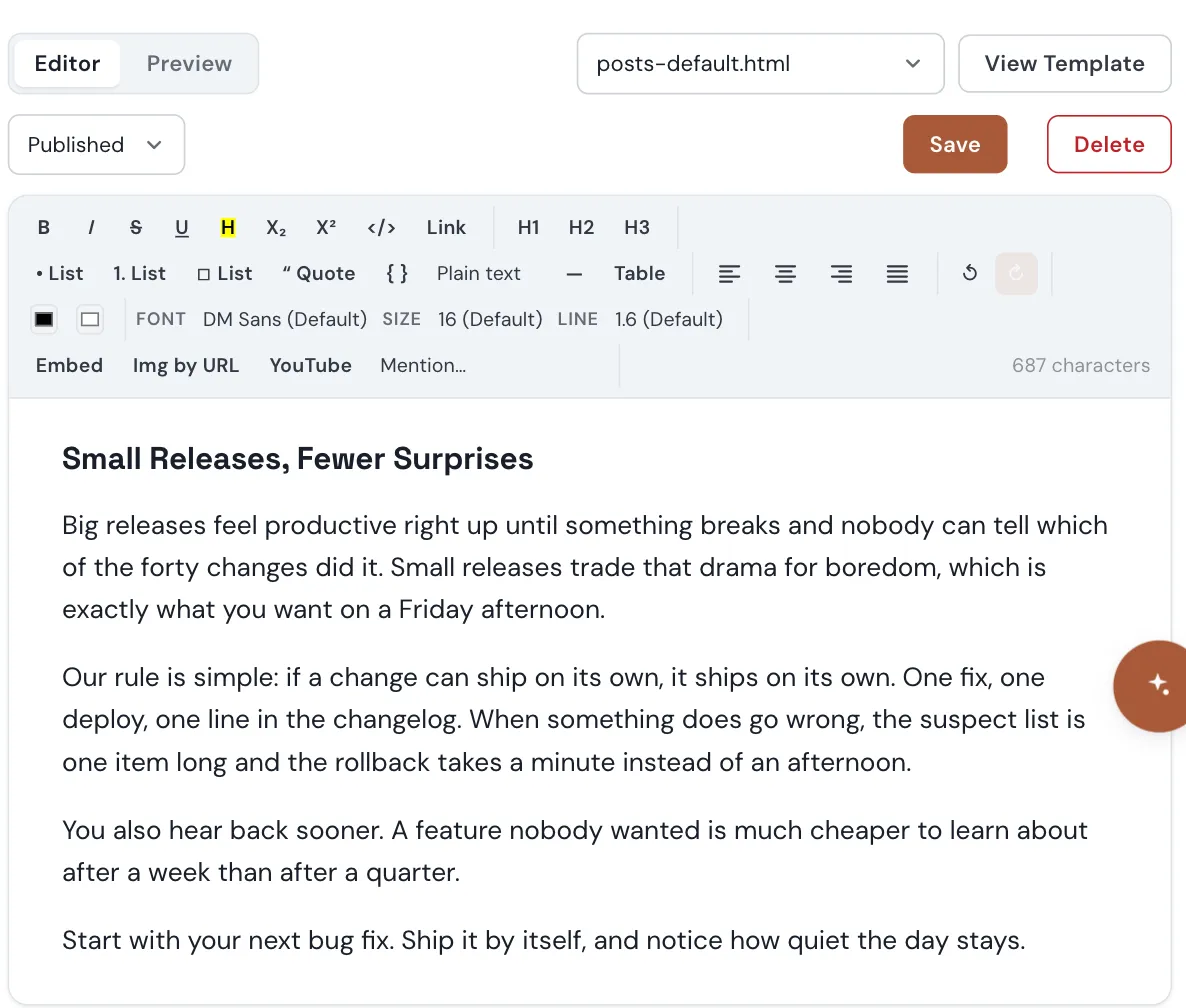
- Formatting — headings, lists, checklists, quotes, code, tables, colors, fonts.
- Media — images, YouTube, and embeds of other content on your site.
- Template — each post picks a layout from your theme, like
posts-default.html.
What you write is saved as structured content, not HTML, so a theme can restyle every post without touching them.
Which one should I use?
News, updates, or a series? Make it a post. If it needs a custom layout, or still makes sense a year from now without a date, make it a page.
Showing a post on a Page
A Post can't hold HTML, but a Page can show a Post. Add a marker — a tag with a data-embed-config attribute — with the Post's slug, the same one shown in the admin editor's address bar. An id also works, and wins if both are set.
<section data-embed-config='{"type":"content","slug":"small-releases-fewer-surprises"}'></section>That marker, live:
Small Releases, Fewer Surprises
Big releases feel productive right up until something breaks and nobody can tell which of the forty changes did it. Small releases trade that drama for boredom, which is exactly what you want on a Friday afternoon.
Our rule is simple: if a change can ship on its own, it ships on its own. One fix, one deploy, one line in the changelog. When something does go wrong, the suspect list is one item long and the rollback takes a minute instead of an afternoon.
You also hear back sooner. A feature nobody wanted is much cheaper to learn about after a week than after a quarter.
Start with your next bug fix. Ship it by itself, and notice how quiet the day stays.
Add "header":false to hide the title and date. See Embeds.
Latest posts
Every published post also shows up automatically in the list below — a post-previews marker, wired into this page's template.
<section data-embed-config='{"type":"post-previews","limit":6}'></section>limit caps how many posts show; omit it and it defaults to 6.